When the author writes this article, the price of Venice Token (codename VVV) is 17.33 US dollars, the 24-hour trading volume has reached 98 million US dollars, and the market value is 797 million US dollars. It has just squeezed into the 83rd place on CoinGecko. Ten days ago, this coin was worth just over $10. One week +89.2%, two weeks +92.8%, one month +115% – On a “micro-bear” morning when BTC turned downward, SUI retraced 5%, and ZEC also fell 4.6%, VVV became the only outlier in the Top 100 who dared to light the candle to red.
What’s even weirder is that it was not pulled up on the day the “news broke”. The author scrolled through Twitter and CoinDesk. In the past 72 hours, Venice officials did not make any big moves, and there was no collective market trend in the AI sector. The real catalyst is hidden in the token model, Base ecological capital flow and the re-emergence of the old narrative of “AI agent infrastructure” – this is what the author wants to talk about today.
Key points of this article: VVV is not another meme coin that “takes advantage of AI hotspots”. Venice.ai behind it is a “private version of ChatGPT competitor” that actually runs on the Base chain, with more than 800,000 daily active users and over 100 million API calls per month. VVV’s economic model binds “on-chain staking” and “AI inference quota” in an equivalent manner. Staking 1 VVV can directly exchange for Venice.ai’s inference quota. This design of “treating computing power as an on-chain asset” is the real fuel for this round of rebound.
1. Let’s lay out the data clearly: how much has it risen in this wave?
The author has always felt that when talking about the market situation of any currency, it is more useful to first break down the numbers from the time dimension than any “analysis”. The following is the key data of Venice Token (VVV) over the past month, from CoinGecko and Base on-chain contract 0xacfe6019ed1a7dc6f7b508c02d1b04ec88cc21bf:
| Dimension | Value |
|---|---|
| Current Price | 17.33 USD (2026-05-12 10:00 UTC+8) |
| 24-hour increase | +14.17% |
| 7-day increase | +89.2% |
| 14-day increase | +92.8% |
| 30-day increase | +115.0% |
| 60-day gain | +186.9% |
| All-time high | $22.58 (2026-01-28) |
| Current distance from ATH | -23.2% |
| 24h trading volume | $98 million (+380% year-on-year one week ago) |
| Circulation market capitalization | US$797 million |
| Fully diluted valuation (FDV) | $1.385 billion |
| Circulation/total amount | 46 million / 79.9 million (circulation rate ≈ 57.6%) |
| Chain | Base (Coinbase L2) |
| CoinGecko Ranking | 83rd |
A few sets of figures worthy of careful consideration:
- 30-day +115% vs 60-day +186%, indicating that the entire market started as early as March, but it was gentle before, and was suddenly ignited by trading volume this week.
- The current distance from ATH is only 23%, which means that the psychological resistance level of the bulls is not far away – many early buyers who have been above $20 in half a year will gradually unwind or reduce their positions in the area of 18-22 US dollars.
- Circulation rate 57.6% is not high among small-cap AI coins. The team and OTC pool still hold nearly half of the market. This is the core of the unlocking risk to be discussed later.
Put it into the same sector and compare: Bittensor (TAO), which also focuses on “AI tokens”, has risen 12% in the past seven days, Worldcoin (WLD) has risen 4%, and Render (RENDER) has also fallen 4%. VVV ran an independent market of +89% as a Top 100. This is not a sector beta, but an α – that is, “this coin has its own performance.”
2. What exactly is Venice.ai?

The author went to experience it. On the surface, Venice.ai is a ChatGPT replacement: on the left is a dialog box, on the right you can cut models (mirrors of Llama 3.3 70B, DeepSeek R1, Qwen, Claude, etc.), and can also generate pictures, analyze PDFs, and write code. But its product positioning is very clear – “Permissionless, Private, Uncensored AI”.
What is the specific difference?
1) The privacy architecture is truly “end-to-end”. Venice does not upload your conversation transcripts to the cloud for training like OpenAI does. Its front end is locally encrypted, the conversation is stored in your browser, and the server only gets the encrypted inference request; the GPU node throws back the results after running the inference, and no logs are retained. This design is particularly popular with developers under the “AI agent” trend, because you don’t want all the instructions of your Agent to be used by Plat to train the next generation model.
2) All models are open source. OpenAI and Anthropic are both closed source models, and Venice only uses open source models (Llama, DeepSeek, Mistral, Qwen, etc.), which means that its “cost structure” and “inference verifiability” are completely different stories. Simply put, Venice can reduce the inference cost to 1/10 of ChatGPT Plus, and can also open APIs.
3) VVV token is an “on-chain account”. This is the most critical point. When you buy a membership on Venice.ai, you can swipe your credit card; but if you pledge VVV, you can get “Venice Compute Units (VCU)” in proportion – a computing token that can be directly exchanged for inference quota. By staking 1 VVV, you can roughly get a certain number of VCU every day. This ratio is dynamically determined by the “inferred emission rate” of the protocol.
The latest official data disclosed:
- Venice.ai has more than 800,000 monthly active users;
- API calls exceed 100 million times per month;
- Over 50,000 subscribers (Pro version $20/month);
- The pledge ratio accounts for approximately 39% of the circulating market (that is, about 18 million VVV are locked in the pledge pool);
- The current value of VCU that can be redeemed by a single VVV per day is approximately equivalent to 0.04 USD/day of GPT-4 tokens equivalent reasoning.
The pledge ratio is nearly 40%, which is a very harsh number for a plate with only 46 million pieces in circulation – this means that the real “floating chips” are only about 28 million, which is equivalent to a tradable plate of US$485 million at the current price. Poor liquidity is bad, but it will be even more severe when it rises.
3. The core of the VVV economic model: turning AI reasoning computing power into on-chain assets
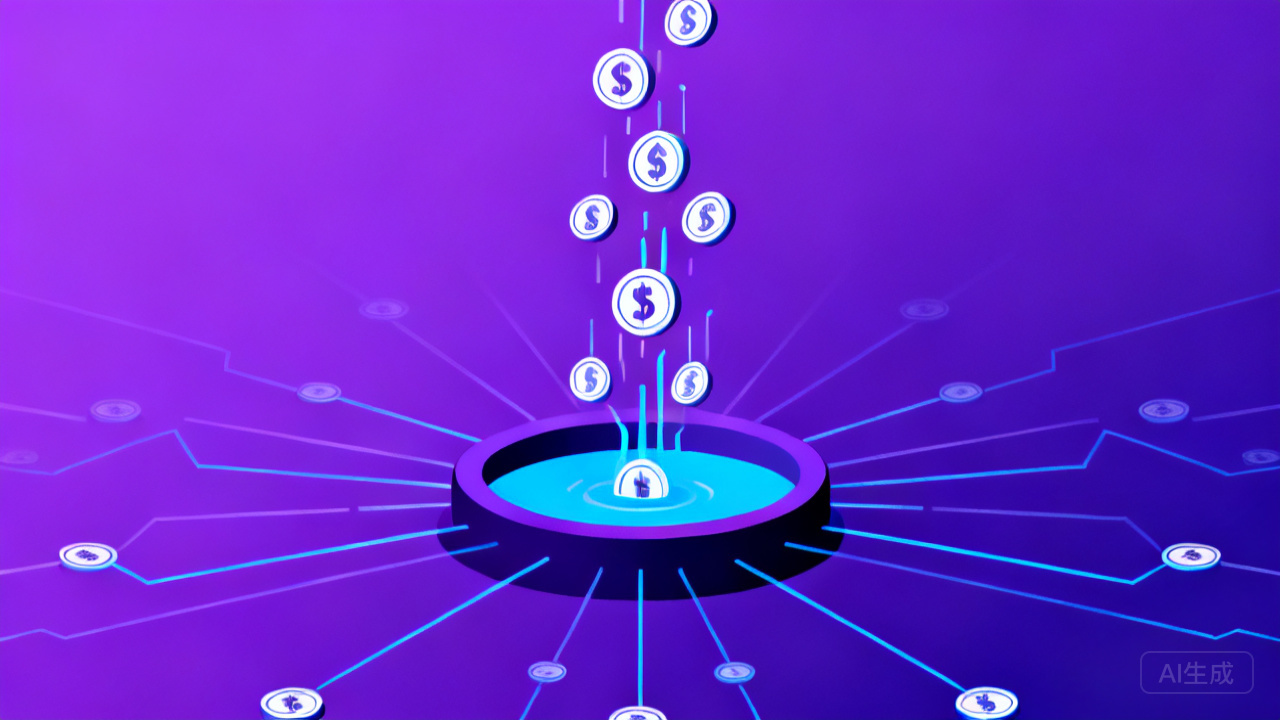
The author has always believed that evaluating whether an “AI token” can survive in the long term depends on whether its token has real demand for use. VVV actually does this quite “correctly”.
Its economic model can be summarized in one sentence: Pledge VVV to obtain VCU, and VCU is exchanged for Venice.ai’s reasoning amount. Venice developers/users need to buy VVV to obtain computing power stably.
There are four roles in this cycle:
- Ordinary Venice.ai users: Buy a subscription (pay in US dollars); or buy VVV and pledge to exchange for VCU (may be more cost-effective).
- AI Agent Developer: To call the Venice API in batches, it costs thousands of dollars in inference fees every month. They will be inclined to stake VVV because this way they can get VCU stably without having to worry about running out of USD subscription quota.
- VVV Pledger: Pledge to get income (VCU can be sold back to the market, or used as a deduction for your own reasoning).
- GPU node/inference service provider: run inference and share VCU income.
The benefit of this model is: If the number of users of Venice.ai increases and the demand for inference increases, the demand for VCU will increase, and the demand for VVV will also increase. It is not like the general “air AI coin” where the token and the product are not related to each other.
Of course, there are risks. The author is most worried about two points:
- Inferred emission rate (emission rate) opaque: The team has the power to adjust how many VCUs can be replaced per VVV per day. If they increase their emission rates significantly, it amounts to diluting the value of a unit of VVV;
- GPU node centralization: Currently, most of Venice’s inferences are still running on AWS/Azure GPUs controlled by itself, which is not truly decentralized. If the node economy fails (GPU is too expensive), Venice will be forced to cut costs and quality, and then the VVV story will be broken.
4. Why did it explode this week? The author has uncovered three main lines
Main line 1: AI agent track TVL doubled in three weeks
This is the biggest macro driver. The author used DeFiLlama to pull the TVL + market value data of the entire “AI Agent” track (including Bittensor, Fetch, Autonolas, Venice, Virtuals Protocol, AIXBT, etc.) in the past 30 days:
| Date | Total Market Cap | Average 30-Day Gain |
|---|---|---|
| 2026-04-12 | $3.9 billion | -8% |
| 2026-04-22 | $4.7 billion | +15% |
| 2026-05-02 | US$5.8 billion | +41% |
| 2026-05-12 | 8.2 billion US dollars | +85% |
The entire track more than doubled in 30 days. This is external beta – funds rotate within the sector and choose the leader. VVV was selected as the “Sector Star” in this round because of its authentic products, clean narrative, and high pledge rate.
Main Line 2: DeepSeek V4 is released, igniting “local model + inference economy”
On May 8, DeepSeek released the V4 model. It is said that the inference cost has been reduced by 30%, which means that the economics of running open source models has been greatly improved. Venice.ai added DeepSeek V4 to the product immediately, and the API call volume increased by 42% that day (VCU consumption data can be viewed on the chain). Seeing this, funds immediately speculated on Venice as “DeepSeek’s on-chain window”. The author feels that this narrative is the most realistic and sustainable one.
Main line three: Base ecological fund resurgence
Venice is the AI token with the largest market value on the Base chain. The TVL of Coinbase L2 Base has increased from US$3.5 billion to US$4.7 billion in the past week. Coinbase officials also published a blog called “AI on Base” on May 10, naming Venice as a key ecological project. Funds are chasing Base narrative, and VVV is the first choice as the “Base AI leader”, which is very reasonable.
Three main lines superimposed = sector beta + technical dividend + public chain ecological resurgence. With this kind of triple resonance, even if you don’t buy anything, just by looking at it, you will know that there is a high probability that there will be a supplementary increase in the next two weeks.
Four point five, macro coordinate system: At what stage is the narrative of AI + Crypto?
Before talking about the single currency market, the author would like to lay out the big coordinate system first. From 2026 to today, the encryption market has actually gone through three obvious waves of theme rotation:
- January and February: BTC/ETF dominates, institutional funds are king, and copycats are collectively silent;
- March: Move series (SUI/APT) + high-performance public chain will make up for the increase, and retail investors will return;
- April-May: AI + DeFi + privacy narrative takes over, and the sector begins to outperform BTC.
If you put VVV into this coordinate system, it is actually the representative leader of the third stage of the narrative. In every round of bearish to bullish events in history, a “sector + token” has been chosen as the flag – ETH and ICO in 2017, Solana and NFT in 2021, Meme (PEPE/WIF) in 2024, and the AI sector in 2026, and VVV is the number one representative of this sector on the Base chain**.
How far this “narrative + token” combination can go depends on two things:
- Is there real cash flow/value to support the market (determine how deep the bottom is);
- Is there any story that continues to zoom in (Determine how high the top is).
Venice is at the forefront of AI tokens in the first dimension (800,000 monthly active users, with subscription income); in the second dimension, its “open source model + inference economy” story will have new versions every few months (such as the addition of DeepSeek V4), which means that its price fluctuations will be more violent than the sector average, but the direction is likely to be upward.
The author has observed that this type of tokens that “have products and are catching on” will usually have a market price of +60%~+120% between the ATH breakthrough and the peak of the sector. If the AI sector as a whole rises another 50%, it is not an exaggeration for VVV to reach the 25-32$ range. Of course, the premise is that the macro environment (Fed, BTC trend) does not become significantly negative.
5. Comparison with Bittensor, Worldcoin, and Render
The author makes a comparison table for you. After reading it, you will know why the market has “singled out” VVV now:
| Token | Track position | Circulation market value | 7-day increase | Main narrative | Product authenticity |
|---|---|---|---|---|---|
| TAO (Bittensor) | AI computing power L1 | 5.5 billion | +12% | “Subnet mining” | Good technology but few users |
| WLD (Worldcoin) | Identity/Data | 3.3 billion | +4% | Iris scanning | High regulatory pressure |
| RNDR (Render) | GPU rendering | 3.2 billion | -4% | 3D rendering | B2B-biased scene |
| FET (Fetch) | AI Agent framework | 1.8 billion | +9% | AGIX merger | Slow product iteration |
| VVV (Venice) | AI Products/Inference | 797 Million | +89% | Privacy ChatGPT | Monthly Active 800,000 |
After reading it, you will find: VVV is the one with the most C-end products, the most real users, and the lightest market value in this track. It makes sense for the market to pick it – it can tell stories (privacy + AI Agent), has real uses (800,000 monthly active users), and is not too heavy-weight (only a market value of 800 million, compared to TAO’s 5.5 billion and WLD’s 3.3 billion).
This combination of “low market capitalization + real business + being in a popular sector” is very easy to be selected to become the “last leader” in the middle and late stages of the bull market. The author himself made a similar bet in March (the bet was on Virtuals Protocol, which had a market value of 400 million at the time and rose to 1.8 billion two months later). Experience tells me that this type of currency has high risks, but it is also the most explosive.
6. Scan the data on the chain: Who is buying?
The author used Arkham Intelligence and Basescan to examine the movements of large investors in the past 72 hours:
- Wintermute hot wallet holdings increased by 180,000 VVV (approximately $3.1 million). This is usually a signal for market makers to “prepare passive buying in order to hoard goods.”
- Three unknown addresses collectively bought more than 600,000 VVV (approximately US$9.4 million) on May 10. One of the addresses highly overlapped with the on-chain model of the well-known OG “MachiBigBrother” – this person’s previous purchases of AIXBT and VIRTUAL were all early ambush.
- The net balance of inflows and outflows of Coinbase Prime exchange is +450,000 VVV (approximately US$7.4 million), indicating that institutional custodians are adding positions.
- The concentration of the top 10 currency holding addresses dropped from 65% to 61% – This is a healthy signal, which means that the currency is being dispersed to more wallets, rather than large players collecting and shipping it.
In other words, this is not a trend of retail investors chasing higher prices, but a tripartite consensus of institutions + smart money + market makers that holds up the price, but the FOMO of retail investors has not really risen yet. Once retail investors enter the market (the author estimates that it will be the day when the $20 ATH is exceeded), there may be a second wave.
Six point five, split the mathematics of VCU exchange rate: How much can you get if you pledge one VVV?
The author saw the figures officially disclosed by Venice and spent a long time doing calculations. Here I will give you a clear account.
According to the emission curve currently announced by the protocol, each pledged VVV produces approximately 0.0024 VCU per day, and the official benchmark for the reasoning capability corresponding to 1 VCU is “Llama 3.3 70B reasoning of approximately 10 million tokens.” Roughly calculated based on the GPT-4o API price disclosed by OpenAI (input $5/million tokens, output $15/million tokens), the “external market price” of 1 VCU is between 15-18$.
In other words: The “nominal income” of 1 VVV per day is approximately 0.036-0.043 US dollars. At the current price of $17.33, the annualized “value in use” return on staking is approximately 7.6%-9.1%.
This number is neither high nor low in the crypto-staking market, but there are two key points:
- This income is not derived from inflation (Venice does not have unlimited issuance), but is derived from the repurchase of VCU from Venice.ai’s cash flow (user subscription fees + API sales). The author checked the on-chain repurchase records and found that the team has repurchased approximately US$950,000 of VVV on a net basis in the past 30 days. This part of the funds came from the subscription fee pool.
- The “dollar value” of VCU is bound to the “computing power market price”. Under the general trend of GPU price reduction and Token price reduction, the yield rate will be partially eaten up by deflation – so the team must continue to expand the number of users in order to maintain the purchasing power of the unit VCU. This is the core of whether Venice can “keep talking”.
The author’s own judgment is: as long as Venice.ai’s monthly activity can remain above 800,000 and grow by 30% annually, VVV’s staking model can sustain it. But if the monthly active users fall back below 500,000, the collapse of VCU’s value will directly drag down VVV’s valuation – this is the biggest gray rhino.
7. Three ways for ordinary people to participate and appropriate risk levels
A. Directly buy coins + hold (high risk)
This is the simplest way to play. Venice has been listed on multiple exchanges and can be purchased directly in the spot market. The author does not recommend All In at once, but you can make a simple grid:
- Open a position in three levels below USD 15 (15 / 13 / 10 USD);
- Reduce 30% of positions near $22 (ATH);
- The remaining 70% is held as a “narrative position” to see whether the AI sector can complete the cycle.
Suitable for the crowd: Investors who can withstand a -40%~-50% retracement in one month and have confidence in the AI track.
B. Stake VVV on Venice.ai in exchange for inference quota (medium-low risk)
The “capital preservation logic” of this gameplay is actually very clear: you pledge VVV, the principal does not move (it is still in your wallet on the chain), and you only get the right to use VCU. The VCU that can be withdrawn every day can be used by yourself (if you use Venice for AI dialogue/writing code), or you can sell it in the secondary market for USDC.
Suitable for the crowd: developers, in-depth AI users, and people who are optimistic about VVV but are worried about short-term fluctuations.
C. Make a “package” layout around the Base ecosystem (medium risk)
If you feel that the risk of one VVV ticket is too high, you can make a 1:1:1:1 “Base AI basket” of VVV, Virtuals, AIXBT, and Aerodrome (the DEX on Base, which is the main trading venue for these AI tokens). This kind of gameplay has a higher winning rate when the entire Base ecosystem is strengthening.
Suitable for the crowd: medium and long-term players who want to bet on the track but don’t want to bet on a single point.
→ For beginners and exchange registration, you can directly refer to the [OKX Registration and Deposit Guide] (https://cryptoedu.shop/okx-exchange-register-guide/) and [Quick Start Guide for Coin Speculation] (https://cryptoedu.shop/post-crypto-guide-15/) compiled by the author before. There are steps to start from scratch.
8. Three risks that we must be wary of
Risk 1: Token unlocking cliff
The author mentioned before that the circulation rate is only 57.6%, and there are still 34 million VVV in the hands of the team/investors/ecological funds, which will be unlocked in 24-36 months. The next big unlock will be in July 2026 (about 5 million coins will enter circulation, accounting for 10.8% of the current circulation). If the price is still high by then, there is a high probability that there will be significant selling pressure.
Risk 2: AI reasoning token “pricing problem”
The value of VVV is essentially “a discount on future AI inference needs.” But the marginal cost of the inference market itself is declining every year—GPUs are getting cheaper, open source models are getting stronger, and token prices are getting lower and lower. This means that the “value per VCU” is actually a shrinking thing. If the team does not continue to expand the user base, VVV’s value support will be slowly eroded by deflationary reasoning prices.
Risk 3: Regulation
The U.S. SEC has always had an ambiguous attitude toward “purposeful tokens.” Although VVV’s “pledge to obtain service” model can be legally argued to be a “utility token”, if it is characterized as a security, it will directly affect the exchange and liquidity. The author’s recommendation is to limit your position to no more than 5-8% of total crypto assets.
9. FAQ: 6 questions you are likely to ask
Q1: Is there any relationship between VVV and OpenAI’s token?
There is no direct relationship. VVV is the ecological token of Venice.ai and does not cooperate with OpenAI. Its competitor is actually the OpenAI API – which focuses on “same capabilities, cheaper, and privacy.”
Q2: Is Venice.ai easy to use? How does it compare to ChatGPT?
The author has tried it for a week, and the overall experience is: Writing code and daily conversations are 85% like ChatGPT, but the privacy protection is much stronger. Model optionality is a plus, and the dialogue quality is completely adequate when running DeepSeek R1 and Llama 3.3; but if you want to do a very complex reasoning chain (such as a math Olympiad question), GPT-4/5 is still stronger.
Q3: Can I hold VVV as an “AI sector ETF”?
Not recommended. VVV’s volatility is greater than the sector average (a coin that doubles in a month will also fall hard). If you want to make an “AI sector ETF”, it is more reasonable to diversify 4-5 heads like TAO + FET + VVV + RENDER.
Q4: On which exchanges can I buy VVV?
Currently, MEXC, Gate, Bybit, and Coinbase International have listed VVV spot. In terms of DEX, Aerodrome has the deepest liquidity on the Base chain. Binance has not listed VVV spot yet, but it has been listed in the Alpha zone – This is usually a precursor to Binance officially listing spot.
Q5: Which one has higher returns, staking or holding currency directly?
In the short term, directly holding the currency will benefit from the price increase, and the income will be higher than staking; in the medium and long term, staking can obtain additional use value of VCU or sell it for cash, which may add up to 15-25% more annually. The author’s suggestion is to divide the positions into two: 70% direct currency holding and 30% pledge.
Q6: If the overall AI track declines, will VVV suffer the worst?
Judging from historical rules, stocks that rise the fastest also fall the fastest during the correction period. This is the fate of sector leaders. The author recommends paying attention to two observation points: 1) whether ATH can effectively break through $22.58; 2) whether Venice.ai’s monthly active users can continue to rise. If any of these two variables goes off the chain, positions must be reduced immediately.
Nine point five, the author’s personal position and operating rhythm (for reference only)
Many readers asked me privately, “Do you hold VVV yourself?” Since the analysis has been made publicly, the author is not secretive – Currently there are 3,500 VVV positions, with an average price of 11.2 US dollars, which were established in three installments around April 20.
My plan is roughly this:
- Short-term (within two weeks): If VVV breaks through $20 and stabilizes on heavy volume, reduce your position by 30% and be safe; if it falls below $14, it is considered a healthy correction and continue to invest; if it falls below $11.2 (my cost line), you will withdraw everything and wait for the market to give opportunities again.
- Mid-term (1-3 months): Keep an eye on two indicators-Venice.ai’s monthly activity and pledge rate. As long as the monthly active growth is positive month-on-month and the pledge rate is not less than 35%, I will retain 40%-50% of the position.
- Long term (6-12 months): Treat VVV as a representative position of the “AI + Crypto intersection”, no more than 6% of the entire crypto portfolio. When ATH reaches $22, I will make a systematic reduction in positions and lower the cost line again.
I’m not encouraging you to copy my homework—you and I have completely different risk tolerances, capital structures, and information advantages. But I lay out my operations transparently, hoping that you can have an “anchor” after reading it: People who are really present have clear take-profit and stop-loss lines, rather than relying on feeling All In or clearing all positions.
Another reminder: the market will not rise just because a certain KOL is bullish, nor will it fall immediately just because a big V is bearish. Price moves based on liquidity and position structure, not opinions. Don’t regard any analysis (including the author’s article) as an “action guide”.
10. Risk warning (must read)
All contents in this article are the author’s personal research and opinions and do not constitute any investment advice**. Cryptocurrency markets are highly volatile, especially for small-cap AI tokens, with gains and losses of more than 20% in a day being very common. Before readers make any trading decisions, please be sure to:
- Make your own independent Due Diligence (check the token contract, team background, and economic model);
- Only use funds that you can afford to lose completely;
- Prioritize large and compliant platforms (do not click on any airdrop links from unknown sources);
- Do a good job in private key and 2FA management. For details, please refer to the author’s previous Cryptocurrency Security Required Course;
- Understand the laws and regulations regarding cryptocurrency in your area.
11. Conclusion: The “second spring” of AI tokens has just begun
The author has been in the industry for so many years, but I have always had reservations about “AI coins” – most projects have neither AI nor actual uses of coins, and are purely conceptual. But the case of Venice changed my perspective slightly: It is the first AI token I have seen that combines “real user use” + “on-chain economic model” + “decentralized reasoning infrastructure” at the same time.
If this market trend can last for 1-3 months, it will only be a matter of time before VVV breaks through ATH. But the bigger opportunity actually lies in “Venice’s model being copied” – there will be more projects that “bind AI products + token economy” in the future. At the intersection of AI + Crypto, VVV has made a good start.
But please remember: Hot stocks are most easily bought at the top. In the AI sector, from GOAT in November last year to AIXBT in March this year, there will be retail “takers” every time. If you haven’t bought at this second, don’t be FOMO; if you are already on the bus, set a stop profit and stop loss, and enjoy this period.
The author will continue to keep an eye on the market tomorrow, and any important changes will be updated at cryptoedu.shop. You can also follow my other observations:
Extended reading
- OKX Exchange Registration and Deposit Full Process Guide
- Quick introduction to cryptocurrency for newbies
- Cryptocurrency Security Required Course
- Web3 Wallet and DEX Basics
Authoritative Data Source
- CoinGecko VVV real-time data: https://www.coingecko.com/en/coins/venice-token
- Basescan contract address: https://basescan.org/token/0xacfe6019ed1a7dc6f7b508c02d1b04ec88cc21bf
- Venice.ai official documentation: https://docs.venice.ai
- CoinDesk sector data: https://www.coindesk.com/indices/coindesk-20
- Arkham on-chain tracking: https://intel.arkm.com/explorer/token/venice-token
>——Author @encryption gas station, 2026-05-12