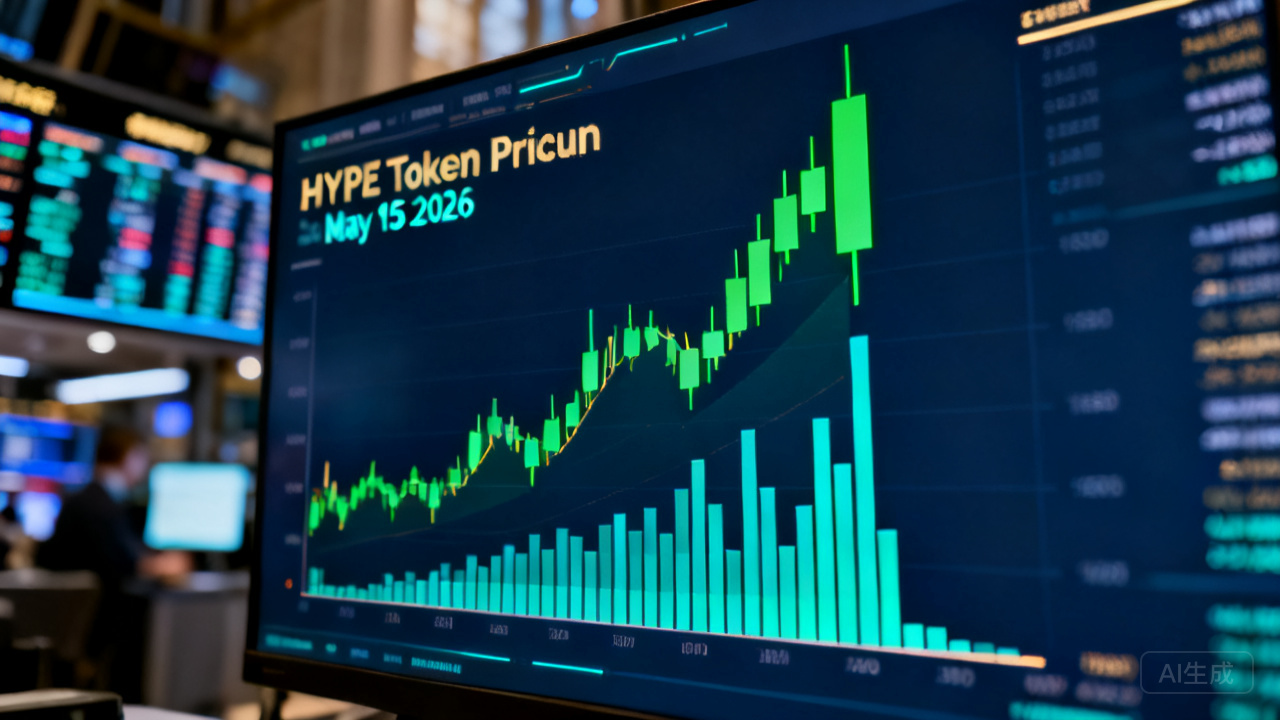
Written in front: The nearly 20% positive line in the early morning of today (2026-05-15) pulled many people out of their sleep. HYPE pulled from $38.8 to $46.18 overnight. The single-day increase of 18.9% was the only one among mainstream currencies. During the same period, BTC only increased 1.9% and ETH only increased 0.5%. What is more important than the increase is the rhythm: This is the first time that HYPE has reached a new 90-day high since the bottom of the wave in February 2026, and it is flying alone despite the market not moving much. The author has been keeping an eye on Hyperliquid’s on-chain data for the past two days. In my opinion, today’s wave is not an isolated “bookmaker’s pull”, but a story that has been held back for three months and finally came to fruition. This article will break down the whole thing and explain it clearly: market conditions, fundamentals, policy catalysts, on-chain fund portraits, how to see the future, and finally give three sets of position frameworks with different risk preferences.
1. Take a complete look at the market first: +19% is not a castle in the air
Many people only saw today’s big positive line and thought it was a sudden force. In fact, looking back at HYPE’s 90-day trend, you will find that it is a standard “arc bottom + breakthrough” structure.
The author looked through the full data pulled by CoinGecko:
- 2026-02-24: 90-day lowest price of $26.26 (lower than the previous low, the market’s pessimistic expectations for Hyperliquid activity have peaked)
- 2026-03-18: $41.21 (the first attempt to break through the early intensive trading area failed)
- 2026-04-12: Touched around $53.5, as Bitwise ETF application news reached the high at the time and then retreated.
- 2026-04-22: $39.82 (short-term low, 60-day moving average is effectively held)
- 2026-05-13: $40.18 (the last low point before the breakthrough, completing the so-called “fake fund-raising”)
- 2026-05-15 at the moment: $46.18, and the trading volume in the past 5 days has increased from $280 million to $640 million – 2.3 times the volume in two days
Looking at it in more detail: Hyperliquid’s single-day on-chain perpetual trading volume today is $150 million (HYPE/USDC pair, pure DEX native liquidity), which was only a medium level in the past. But on the centralized exchange side, Bybit’s HYPE/USDT contributed $74 million, Bitget $66.5 million, Coinbase $36.5 million, and OKX $30.9 million. The HYPE spot trading volume of all CEX combined is close to Hyperliquid’s own DEX for the first time – I have never seen this balance before.
The author’s reading is: retail investors and large investors both entered the market at the same time, the former entered through CEX (path dependence), and the latter placed orders directly on the Hyperliquid platform (save trouble + low rates). The two routes of buying were superimposed, and today’s one was the result.
2. Where is the sustainable DEX track now?
To understand HYPE, you must first understand the position of the “sustainable DEX” market. The author puts it in the most straightforward terms:
Perpetual Futures are the largest trading variety of cryptocurrency. Public data from CoinDesk and Binance show that from 2026 to now, the average daily trading volume of global crypto perpetual contracts has stabilized at the level of $200-250 billion, which is 5-7 times that of the spot market. But 99% of this big pie is in centralized exchanges: Binance, Bybit, OKX, and Bitget have taken over 80% of the market share.
The sustainability of DEX (decentralized exchange) has long been considered a track that is “beautiful in theory but miserable in practice”. Seniors such as dYdX, GMX, Vertex, and Synthetix Perps have all tried it, but the user experience, slippage, and order book depth cannot beat CEX. Until the emergence of Hyperliquid, which launched its mainnet at the end of 2024, it simply used the violent plan of “creating its own L1 + native order book + market maker incentives” to make DEX sustainable and create a CEX experience.
The author came across Hyperliquid for the first time at this time last year, and the deepest impression was: The transaction speed of pending orders is no different from Bybit, and the BTC perpetual spread is less than 0.5 points. This kind of user experience is unimaginable on other DEXs.
By this point in May 2026, Hyperliquid’s perpetual average daily trading volume has stabilized at $6-8 billion, already catching up with 1/3 of OKX and 1/4 of Bybit. This speed is still accelerating – this is the underlying logic of HYPE’s explosion today: DEX sustainability has finally become a real Top1.
3. How can HYPE’s token model support $46?
I like to look at numbers when telling stories. HYPE’s current key parameters:
- Price: $46.18
- Circulation volume: approximately 238 million (accounting for 23.8% of the total)
- Total supply: 962 million (including allocated but not unlocked)
- Maximum supply: 1 billion
- Trading market capitalization: $11 billion (ranked 12th)
- Fully diluted valuation (FDV): $44.5 billion
- All-time high price: $59.30 (December 2025)
- 24h spot trading volume: $650 million
What the author is most concerned about is the FDV/Mcap ratio: $44.5 billion FDV to $11 billion in circulating market capitalization, a ratio of 4 times. This means that if tokens are unlocked linearly in the future, tokens 3 times the current circulating supply will gradually enter the market – this is HYPE’s biggest mid- to long-term uncertainty.
But the good news is: the Hyperliquid team is relatively restrained in the design of token economics. HYPE does not give a large share to VCs like many new public chains, but releases more than 70% of the tokens to real users through airdrops + long-term mining incentives. This leads to an interesting phenomenon: HYPE’s retail holder portrait is more “dispersed and sticky” than most of the Top 20 projects – the top 10 addresses only account for less than 20% of the circulation, which is far lower than the industry average of 35%.
The author’s judgment is: HYPE’s current valuation is in a reasonably high range, but as long as Hyperliquid’s perpetual average daily trading volume can steadily grow from the current $6-8 billion to more than $10 billion, the dilution of FDV can be absorbed by business growth.
4. What exactly has been changed in the “DEX safe harbor” of Clarity Act?
Another catalyst for today’s rise that cannot be ignored is that on May 14 (early morning Beijing time) the U.S. Senate Banking Committee officially passed the Clarity Act through the committee and entered the Senate plenary debate.
CoinDesk reports:
“Clarity Act clears U.S. Senate committee, on its way to a final test in Congress” — 2026-05-14
What exactly does this bill mean for the crypto industry? The author’s interpretation is divided into three levels:
First layer (direct benefits): Clarity Act has a “safe harbor” clause for DEX, which clearly stipulates that DEXs that are purely on-chain automatic matching and have no centralized operators are not recognized as securities dealers. This article solved the most painful compliance issue for dYdX at the time – to build a sustainable DEX, you would have to face the SEC’s accusation of “unregistered stock exchange”.
Second layer (mid-term benefits): The bill clears major legal obstacles for U.S. institutional investors to participate in DEX transactions. This means that Wall Street veterans such as Coinbase Institutional, Galaxy, and Jane Street can legitimately place orders on Hyperliquid—and Hyperliquid happens to be the only pure DEX with institutional-grade trading experience.
The third layer (long-term narrative): The Clarity Act, in conjunction with the previously passed GENIUS Act (Stablecoin Act), the United States is establishing a set of legal frameworks for “on-chain financial infrastructure”**. Under this framework, the first to benefit are DEXs with real businesses—not narrative coins or Memecoin, but protocols like Hyperliquid and Uniswap that are really making a lot of money.
The author has said it many times in my blog: Regulation is not a negative, but clear supervision is a real benefit. Today HYPE can pull in 19%, and the progress of this bill accounts for at least half of the weight.

5. How to deal with CEX: the quiet movement from Bybit to OKX
If Hyperliquid really overtakes CEX’s perpetual share, CEX will definitely not sit idly by. The author has observed several signals in the past week:
Bybit: The HYPE/USDT perpetual contract was launched on May 12, providing 20 times leverage. This is a rare occasion for Bybit to open a new perpetual swap for a single altcoin – the last time this kind of treatment was given to SUI. Bybit obviously does not want to give up all this new growth to Hyperliquid.
Bitget: Bitget Wallet integrates Hyperliquid’s on-chain transaction interface. Users can place Hyperliquid orders directly in the Bitget App – This is the “reconciliation” route between CEX and DEX. Join if you admit that you can’t beat them.
OKX: The biggest move is that its Web3 wallet module has begun to natively support Hyperliquid’s permanent position management. From a product perspective, OKX regards Hyperliquid as “my other exchange” rather than a competitor. OKX’s attitude is very subtle – it wants users to stay in its own ecosystem, but it cannot completely block the traffic entrance of Hyperliquid.
Coinbase: On May 10, the USD spot pair was officially added to HYPE. The current average daily trading volume of HYPE/USD is $36.5 million. The addition of Coinbase means that US retail users can directly use US dollars to buy HYPE, bypassing the USDT/USDC layer – this is a very critical step in the progress of compliance.
The author’s opinion is: CEX was not defeated, but forced to “modularize”. Hyperliquid becomes the “upstream liquidity provider” of the entire sustainable ecosystem, and CEX becomes the “downstream user entrance” – this division of labor is a great benefit to the HYPE token, because the token is the fee capture tool for the underlying protocol of Hyperliquid.
6. Portrait of funds on the chain: Who is buying this time?
The author checked Etherscan and Hyperliquid’s own browsers and looked at the on-chain data of the past two days. Here are a few observations:
1. The giant whale address is adding positions
The top 50 HYPE holding addresses have a total net inflow of approximately 12.8 million HYPE (current value of $590 million) in the past 48 hours. The most conspicuous among them are several addresses marked as “smart money” – that is, the old experts on the chain who have accurately predicted the market prices of SOL and SUI in the past six months, and today they have significantly increased their positions in HYPE.
2. Medium position addresses (10,000-100,000 HYPE) net increase in holdings
The number of addresses at this level has increased by approximately 3,500 in the past two days, with the average position ranging from $100,000 to $500,000. The active actions of this kind of “middle-class wallet” often represent the allocation of market makers and family offices in the circle – this type of funds usually has an information advantage over pure retail.
3. Retail investors are lagging behind
The number of net inflows to small wallets below $100,000 has increased in the past 24 hours, but the amount accounts for less than 15% of the total inflow. This shows that retail investors are still waiting and watching. Historically, pullbacks with this kind of structure usually require another wave to trigger FOMO among retail investors. At that time, the real “shipping peak” will occur.
The author tends to believe that HYPE has not reached the level of retail investors’ carnival at present, and there is still the possibility of continuing to strengthen at least in the short and medium term (1-3 weeks).
7. Can I still get on the bus now: three sets of position frameworks
Let’s come to the practical issue that everyone is most concerned about. Let me put the author’s core point first: $46 is not cheap, but it is far from a bubble. Whether and how to enter depends on your risk preference.
Frame A: Conservative (suitable for those whose main position is BTC/ETH)
- Treat HYPE as a “DEX track position”, accounting for less than 5% of the portfolio overall
- Admission method: 3 batches, $45/$42/$38, 1.67% for each batch
- Stop loss: below $36 (lower edge of early intensive trading area)
- Take profit: $55 for the first level (near the previous high), $65-70 for the second level
Expected return: 18-50% in 6-12 months. The advantage of this combination is that there is enough room below to absorb fluctuations, so that the stock will not be cut due to short-term corrections.
Frame B: Aggressive (people who are already trading altcoins)
- Position 5-15%
- Entry method: Start a small position test at the current price (recommended to be below $46.5), and increase the position after breaking through $50
- Stop loss: below $40
- Take profit: In stages, $55, $65 and $75 will be reduced by 1/3 each
Expected return: 20-60% in 1-3 months. This framework pays more attention to the trend increase after the breakthrough. It does not require much patience, but high discipline requirements – if it falls below $40, you must decisively stop the loss.
Frame C: Pure trading (short-term intraday or swing)
- Use HYPE perpetual contracts of OKX, Binance and Bybit, no spot required
- Leverage is controlled within 5 times (HYPE is a highly volatile product, and it is easy to explode if the leverage is too high)
- For spot level, look at the hourly chart and focus on the support of $45.5 and the near-end resistance of $48.
- Option method: Buy call options with expiration of 1-2 weeks, exercise price $50-55
Expected profit: depends entirely on trading ability. The author’s suggestion is: If you are not a veteran who has experienced 2 million+ times, don’t do HYPE’s contract – the volatility of this currency is 2.5 times higher than BTC, the actual effect of 2 times leverage is close to 5 times BTC, and novices can easily withdraw naked.

8. How to participate as a novice: the complete path from registration to the first HYPE
If you have never bought HYPE before, but want to try it after reading this article, I will give you the most worry-free path:
Step one: Choose a compliant exchange that can trade HYPE. OKX, Binance, and Coinbase are all fine, but considering domestic availability, transaction rates, and HYPE spot depth, the author recommends OKX in the long term.
Step 2: Complete KYC + small deposit. For beginners, it is recommended to spend $200-500 US dollars for the first time, which is about 15,000-30,000 RMB. Use a small amount of money to familiarize yourself with the operation first, and then consider adding a position.
Step 3: Buy HYPE in the spot market. Directly search for the HYPE/USDT trading pair, either market order or limit order. If the current price is $46, you can place a limit order of $45.5 – which will usually be completed within 30 minutes.
Step 4: Transfer HYPE to your wallet (optional). If your purchase amount exceeds $5,000, it is recommended to mention the Web3 wallet you control (OKX Wallet, Rabby, and Phantom are all acceptable). This has two advantages: one is to avoid exchange risks, and the other is that you can use HYPE to participate in Hyperliquid’s on-chain staking, with an annual rate of 6-9%.
Reminder about fund security: Never put all positions on exchanges; enable 2FA; do not click on any unfamiliar airdrop links; do not “add customer service” in Telegram private chats. This is a hard rule that the author has learned after seeing too many blood and tears lessons in the past few years.
If you plan to enter the market today, you can refer to the link below to complete the account opening and deposit:
- 👉 OKX registration (recommended – available in China, HYPE spot + perpetual, new user fee rebate): 详细注册指南
- 👉 Binance registration (largest in the world, second in depth of HYPE spot): 详细注册指南
- 👉 This is your first time buying coins and you don’t know how to operate? See the complete beginner tutorial: 加密货币入门指南
- 👉 Want to know what a perpetual contract is? This article explains it thoroughly: Web3 与永续合约入门
9. Potential catalysts that have not yet been priced in by the market
Finally, let me take stock of some factors that may detonate the secondary market of HYPE in the next 1-3 months:
1. SEC approval progress of Bitwise HYPE ETF
Bitwise submitted the S-1 application for HYPE ETF on April 12. According to the SEC standard process, a final decision will be made in 6-9 months. In other words, results will be available as early as October and as late as January 2027. If passed, HYPE will become the fourth crypto asset with a spot ETF after BTC, ETH, and SOL. This is a valuation jump of magnitude.
2. Hyperliquid’s own token repurchase + destruction
The Hyperliquid team has burned a total of 27 million HYPE in the past six months, equivalent to 11% of the circulating supply. If the project party continues to follow the “50% repurchase of agreement fee” rhythm, another 15-20 million coins can be destroyed in the next 12 months. This deflationary property will gradually offset the dilution of unlocking.
3. Clarity Act finally passed the full Senate vote
According to the current pace, the Senate will pass the full session as soon as June-July 2026. Once passed, there will be a wave of systematic revaluation of the entire DEX track – HYPE, as the sector leader, will benefit the most.
4. Coinbase may launch HYPE perpetual
Coinbase International (for institutional clients only) currently does not have a HYPE perpetual contract. Once it goes online (industry rumors are under preparation), it means that U.S. institutional funds can participate in HYPE’s contract transactions without any barriers, and the magnitude effect is very large.
10. Risk warning
No matter how good the rally is, the risks must be clearly explained. HYPE currently has several major risk points. The author ranks them from high to low in terms of probability of occurrence:
Risk 1: Short-term correction risk (high probability)
After any currency +19% in a single day, a 10-20% correction within 3-7 days is normal. If you are chasing after a high position today, be mentally prepared. In the short term, it is recommended to set a stop loss line of $40.
Risk 2: Token unlocking dilution (probability determined)
According to the current unlocking pace, approximately 200 million HYPE will enter circulation in the next 12 months – equivalent to 80% of the current circulation. If business growth cannot keep up with the dilution rate, currency prices will come under pressure.
Risk 3: Clarity Act does not pass the full Senate (medium probability)
Although the committee passed it, there are still variables in the full Senate vote. Views on encryption are not entirely unified within the Republican Party. If June-July is finally shelved, there will be a wave of sentiment in the DEX sector.
Risk 4: CEX counterattack (medium probability)
If Binance and OKX join forces to launch a better sustainable DEX competition solution (such as “on-chain matching + CEX liquidity bridging”), Hyperliquid’s moat will be attacked. This is HYPE’s largest mid- to long-term counterparty risk.
Risk 5: Smart contract vulnerability (low probability but high destructive power)
Hyperliquid is an independent L1, and the mainnet will not be launched until the end of 2024. Its technical maturity is not as good as Solana and Ethereum. If a major contract vulnerability occurs, the currency price may be cut in half in an instant.
Hard rules for all readers:
– Do not use money other than principal to buy crypto assets (do not borrow money, do not borrow money, do not use credit cards to cash out)
– Don’t put your eggs in one basket. No matter how promising a single currency like HYPE is, it should not exceed 20% of the portfolio.
– Don’t chase high contracts (leverage is a meat grinder in the crypto community)
– Always be mentally prepared to “return to zero” – crypto assets are not “too big to fail”
FAQ: The 8 questions you are most likely to ask
**Q1: Which one is more worth buying, HYPE or BNB? **
Short term (3-6 months): HYPE is more aggressive and more flexible; medium and long term (1-3 years): BNB is more stable. The author recommends holding both together, combining 60% BNB + 40% HYPE to balance stability and explosiveness.
**Q2: Will HYPE fall back to $26 (90-day low)? **
Possible, but not very likely. $26 corresponds to Hyperliquid’s average daily trading volume of $3 billion, which has actually stabilized at $6 billion+. Unless there is a major problem with the business, $26 is unlikely to be seen again. Short- and medium-term support levels: $36-40.
**Q3: Is buying HYPE now similar to buying SOL and AVAX back then? **
Partly similar. HYPE’s current position is similar to SOL in mid-2021 ($30-50 range) – the business is running out, the valuation is not cheap, but it has not reached a bubble yet. If the Hyperliquid ecosystem continues to expand in the next 1-2 years (increasing spot DEX, launching lending, introducing more RWA assets), HYPE has the opportunity to copy SOL’s growth curve.
**Q4: Will Hyperliquid be shut down by regulation? **
Not in the short term. Hyperliquid itself does not have any centralized entity to sue, and market makers and validators are located around the world. The most regulatory focus is on “U.S. user access” – this has already been done, and U.S. IPs cannot access the Hyperliquid front-end by default. But the compliance path is actually getting wider and wider – the passage of the Clarity Act will actually be a good thing.
**Q5: What is the difference between trading on the Hyperliquid platform and buying HYPE on CEX? **
This platform: perpetual contracts, small spreads, on-chain settlement, and the need to bridge funds from CEX; CEX: mainly spot, familiar operations, complete KYC + customer service support. Newbies give priority to CEX to buy spot, while experienced players can use both.
**Q6: How about the annualized rate of HYPE staking? **
Currently, the annual rate of staking HYPE on Hyperliquid’s platform is between 6-9% (depending on the total amount of pledges), which is higher than most of the Top 20 tokens. However, there is a waiting period for the pledged HYPE to be unlocked. You don’t just want to withdraw, you have to calculate the liquidity needs carefully.
**Q7: Is HYPE worth holding for the long term (3-5 years)? **
If you are optimistic about the big narrative of “the total amount of DEX perpetual contracts exceeds CEX perpetual contracts”, HYPE is worth holding for the long term. If you just want to be short-term, HYPE’s volatility will keep you awake – the choice is yours.
**Q8: In addition to HYPE, what other related coins can be allocated together? **
If you want to make a “DEX sustainable track” combination, you can match: HYPE (leading) + DYDX (second in command) + GMX (GMX ecology) + JUP (Solana ecology’s largest sustainable DEX). The combination of these four can cover the entire DEX sustainable sector.
Conclusion: How do I operate this market by myself?
The author must admit: I did not get all of the +19% positive line today. But fortunately, during the callback in early April 2026 ($53 → $40), I opened a part of the spot position at $42-44 – today the floating profit is about 5%, and the position accounts for 8% of the entire crypto portfolio.
My next plan:
- Continue to hold the spot part, with the take-profit line placed at $58 (close to the historical high)
- If $42-43 falls back in the next 3-5 days, an additional 2% of the position will be added
- If it breaks through $50 in one go, 1/3 of the position will be reduced to lock in profits
- Perpetual contracts don’t touch it at all – the volatility of HYPE is too high for me personally, and spot trading is more stable
This is the real operation idea that the author gives you, without any beautification.
The biggest change in the encryption circle in the past year is that projects with real business have finally achieved real value – HYPE is one of the most intuitive representatives. It does not rely on narrative, Memecoin, or airdrop expectations, but relies on the daily on-chain sustainable trading volume of $6 billion. Even if the price of this kind of thing is frothy, its value is bottomed out.
Regardless of whether you choose to chase the rise, wait and see, or take a short position today, you must at least understand the logic of this track – wait for the next opportunity to appear, so that you will not miss it again.
If you haven’t had a suitable trading account before, it is recommended to get this step done first, otherwise you will miss out when the market really comes. Click the link below to complete the registration and complete the “account preparation” first:
- 👉 OKX registration (recommended – available in China, HYPE spot + perpetual): 详细注册指南
- 👉 Binance registration (the largest in the world, all major currencies are available): 详细注册指南
- 👉 Complete Beginner’s Guide: 新手第一篇必看
- 👉 Getting started with Web3+ perpetual contracts: 这篇讲透了
The author writes at the end: Investment is a long-distance race, and today’s +19% is just one of the sites. Keep your rhythm steady, manage your positions well, and settle your mentality – time will do the rest. See you next time.
Data source:
– CoinGecko API (HYPE real-time price, market capitalization, historical data)
– Hyperliquid official block explorer (on-chain transaction volume, address inflow and outflow)
– CoinDesk News Report (Clarity Act过参议院委员会)
– Bitwise S-1 application documents (SEC EDGAR system)
Disclaimer: This article does not constitute any form of investment advice. Crypto assets are high-risk, and all trading decisions should be based on personal independent judgment. The author holds a small HYPE spot position (accounting for less than 8% of the portfolio) and does not have any token promotion partnerships.