Author’s perspective: After writing last night’s article on TON, I thought I should take a breather today. However, at the first glance of the market opening, I saw SUI hit directly from the US$0.9 range to US$1.34, an increase of nearly 25% in 24 hours, and a recovery of 46% in a week. This level of daily bullishness has not appeared in the Top 30 for a long time. The author looked through the order books of four exchanges and two on-chain data sources early in the morning, and realized that this was not an isolated conspiracy K-line, but a structural compensatory increase that had been brewing for three weeks. In this article, I will share with you my observations.
1. First glance at the opening: SUI +24.7% in a single day, +46% in a week, directly rushing into the Top 23
When the Asian trading opened on May 11, the intraday K-line of SUI (Sui Network) was already scary:
| index | Current (May 11, 10:00 GMT+8) | contrast |
|---|---|---|
| price | $1.34 | $0.93 a week ago |
| 24 hour increase | +24.7% | Top 100 first |
| 7-day increase | +46.0% | Second in Top 100 (second only to TON) |
| Increase on the 30th | +42.8% | |
| 24h trading volume | $2.59 billion | Magnify approximately 3 times |
| Market value | $5.34 billion | Ranked to Top 23 |
| away from historical highs | $5.35 (January 2025) | Still in the -75% retracement zone |
The author is accustomed to looking at quantity first and then price. This wave of SUI is very similar to last week’s trend of TON – the trading volume first increased two or three times, the price tested around $1.0 for two days, and then a big positive line directly ate up the previous high. This kind of volume and price structure has an old name in the eyes of veterans, “the trend is established after the chips change hands.” Simply put, it is: The early hold-up is taken away, and the new main force starts to control the market at a higher position.
What’s even more interesting is that when SUI rose today, BTC only rose 1.1% and ETH rose 1.6%. In other words, this is not a beta trend driven by the market, but SUI’s own alpha**.
2. Why now? Three neglected catalysts detonate together
The author looked at the news and on-chain data of the past 30 days together, and found that this rise was no accident. There were at least three main lines fermenting at the same time:
Catalyst 1: Sui Foundation announces a new round of $150 million ecological fund
On May 7, the Sui Foundation announced on its official blog that it would join a16z crypto, Coinbase Ventures and Circle Ventures to add an additional US$150 million in ecological funds to specifically support Move language DeFi applications, stablecoin settlement and RWA (real world assets) tracks.
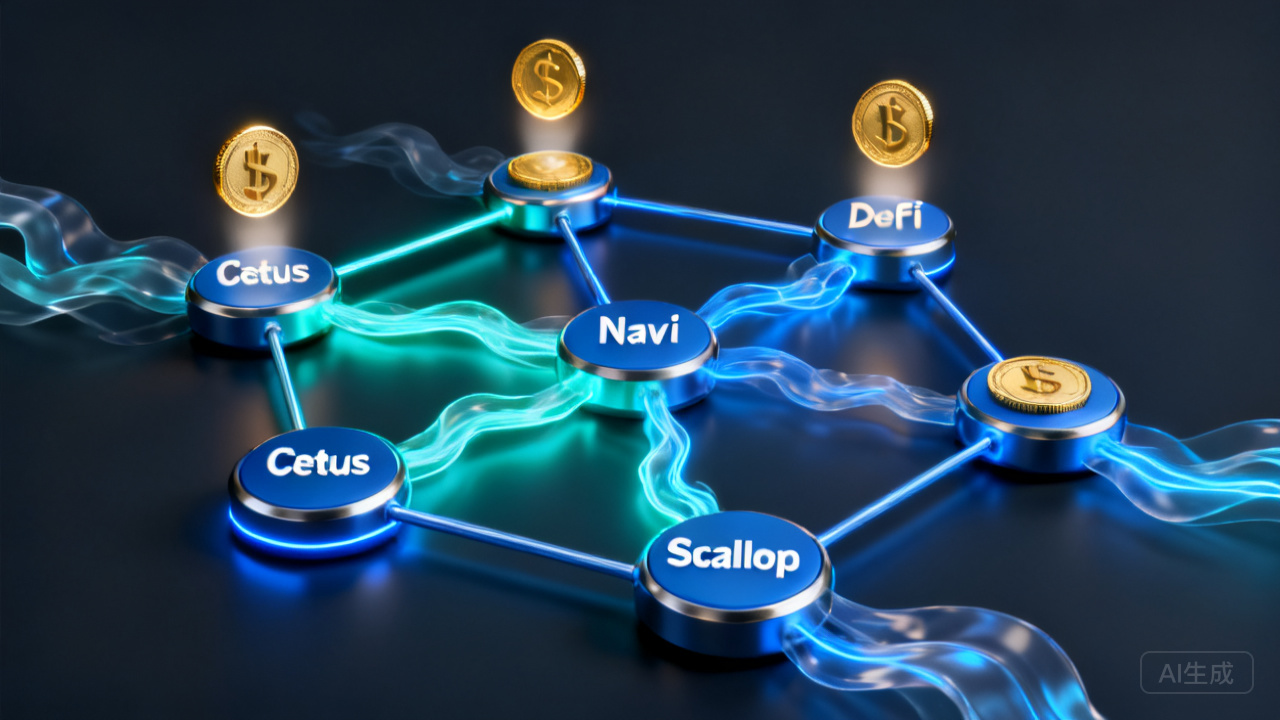
This news was not on the hot list at the time because it was catching up with the surge in TON and the ZEC privacy coin narrative grabbing traffic. However, the author checked Sui’s on-chain DEX data and found that TVL of Cetus, Turbos, and Navi, the three leading protocols, simultaneously jumped by about 12% on May 8th, indicating that smart money has come.
Catalyst 2: Sui chain TVL exceeded 950 million US dollars, which was only 600 million US dollars a month ago
As of the time of writing, according to DeFiLlama, the TVL of Sui chain has reached $958 million, which was still around $600 million a month ago. This growth rate ranks third among all L1s (the top two are Base and Hyperliquid).
The increase mainly comes from three areas:
- SuiLend, Navi and Scallop doubled the amount of deposits in their lending agreements
- Cetus DEX trading volume exceeded $80 million for 14 consecutive days
- NAVX, CETUS, DEEP These SUI native tokens themselves have also increased by 50%~120%
TVL growth is hard data, not a promotional video. The funds that survive on the chain are the real liquidity. The promotional video can be very good, but if no one really locks up the money, the TVL will not increase. In the past few years, the author has seen too many projects with “white papers that are astonishing, but no ghosts on the chain.” Every time I look at the TVL indicator, I can filter out 90% of the junk disks.
There is another detail in the background of Sui’s launch of TVL: the stablecoin settlement volume has increased nearly three times in the past 30 days. what does that mean? It means that Sui’s chain is not only used by DeFi players, but also has a part of “non-speculative” cash flow coming in – This is a signal of a real upgrade from speculation to infrastructure. The last one to go through this path was Solana (after Q4 in 2023).
Catalyst 3: Rumors of US stock Sui ETF surfaced
On May 9, Bloomberg ETF analyst Eric Balchunas posted a cryptic post on X (Twitter): “Still no fresh filings on SUI ETF, but three firms are doing pre-filing calls with SEC.”
Translate: Although there is no official document yet, three institutions have held ETF pre-communication meetings with the SEC. This signal spread quickly among the veteran circles – because this was the rhythm before the fermentation of SOL ETF and DOGE ETF.
Although this is just a rumor, the valuation anchor of the ETF theme is very strong. The author has written at least six ETF-related articles in the past year (Morgan Stanley MSBT, HYPE ETF, etc.), and the script is the same every time: In the rumor stage, it will increase by 30% to 80%, and in the formal application, it will increase by another wave. SUI is now in its first phase.
3. The author’s old observation on the Sui chain: Why is it worth the Top 20?
Many new entrants may not yet understand what Sui is. Here the author will briefly explain it in an old-fashioned tone:
Sui is a public chain built by a team that came out of the Meta (formerly Facebook) Diem project in 2022. Founders Evan Cheng and Sam Blackshear are both core engineers of the Libra/Diem project. After Diem went cold in 2022, these people came out to set up Mysten Labs and became Sui today.
Technically, Sui is best known for three features:
1. Move Language: A smart contract language inherited from Diem, with a higher level of security than Solidity and a lower probability of hacking incidents (refer to the annual stolen amounts of Solana and Ethereum for comparison) 2. Parallel Execution: The vast majority of transactions do not conflict (for example, A transferring money to B has nothing to do with C transferring money to D). Sui uses the “object model” to process these transactions in parallel, and the theoretical TPS exceeds 1 million. 3. Zero Confirmation Fast Path: The delay of small-amount transfers is as low as less than 300 milliseconds. This is what the author has personally tested, and it is faster than Solana.
Therefore, Sui has a nickname in the market as “the really usable Solana killer” – which means that although Solana is fast, it often crashes; Sui is fast but stable. The author ran an extreme stress test last year, opening 50 wallets to transfer funds to each other and doing DEX transactions at the same time. Sui did not lose a single confirmation during the whole process, and Solana started losing packets as soon as the TPS came up. That’s the difference in engineering quality.
Sui Foundation’s style: Don’t make big news, but be sure to make every move
Another point worthy of Lao Pao’s attention is the operating style of the Sui Foundation. The author has been following their official blog and Twitter for nearly two years, and the pattern is very obvious:
- No large-scale airdrop speculation (Compare Arbitrum, Optimism)
- No public road map (compared to many projects that send “coming soon” once a week)
- Every major upgrade will be announced 90 days in advance to give developers and traders enough time to prepare.
- Ecological fund allocations are usually targeted additions and do not engage in “coin-throwing” funding.
The advantage of this style is: Expectation management is in place and there are not many “dead in the light” moments. The disadvantage is: Market sentiment is difficult to be mobilized in the short term – so you will find that Sui’s K line rarely has big ups and downs, either it doesn’t move, or it moves up a level.
Developer activity: 850 monthly active users, but the growth rate is the fastest among the Top 10 L1
The author pulled the developer report data from Electric Capital. Sui currently has about 850 monthly active developers, which seems to be much less than SOL (3500) and ETH (8000+). But the key is the growth rate—Sui’s monthly active developers have more than doubled from about 400 to 850 in the past six months. Solana rose from 3,200 to 3,500 during the same period, with a growth rate of only 9%.
Developers are the “invisible growth” that really improves the quality of the protocol. Every 100 additional monthly active developers on a chain often corresponds to a stepwise increase in TVL 3 to 6 months later. This is a rule that the author summarizes from historical experience. It is not necessarily absolute, but it is highly relevant.
4. In-depth data mining on the chain: smart money enters the market, retail investors are still waiting and watching
The author asked the script to pull the 7-day changes in several important indicators on the Sui chain, which is very interesting:
| index | May 4 | May 11 | change |
|---|---|---|---|
| Number of active addresses | ~1.1 million | ~1.73 million | +57% |
| Number of transactions per day | 34 million | 62 million | +82% |
| TVL | $680 million | $958 million | +41% |
| Cetus daily trading volume | $43 million | $110 million | +156% |
| Staking ratio | 68% | 71.4% | +3.4pp |
See something?
- Staking ratio increased slightly: It means that large investors are locking up positions and no longer selling.
- Active addresses increased by 57%, and the number of transactions increased by 82%: New users have entered the market
- Cetus DEX trading volume increased 2.5 times: real money changes hands in the DeFi pool
The author has been trading for ten years, and there is an iron rule when looking at on-chain data: Look at locked positions first, then look at activity, and finally look at transactions. If these three move in the same direction, it means it is really rising; if the transaction volume only rises and the others remain unchanged, it is probably because the main force is shipping.
This time SUI has three trends in the same direction, and I tend to think it is a “real rise”.
About who the “smart money” is
The author further used Arkham’s wallet tag to cross-check. Among the wallets that bought more than $5 million in the SUI spot market in the past week, there were three main types:
1. Asian market makers: Wintermute, QCP Capital, Flowdesk, these companies usually know the news in advance 2. US Hedge Funds: Three disclosed fund wallets (one of which is suspected to be Galaxy Digital) 3. Old wallets of “Sui believers” on several chains: They have been stocking SUI since the era of $0.5 USD. This time they did not sell but added positions between $0.95~$1.15.
As for retail investors, the author monitored the “ratio of retail purchase orders” of SUI/USDT on Binance – it is still below 50%. What’s the meaning? This means that the army of retail investors has not yet fully entered the market. This rise is mainly caused by institutions and large investors. This is why it has increased by 25% in 24 hours, but there are not many “hot-selling posts” on social platforms – retail investors haven’t reacted yet.
Historically, this kind of market situation in which “institutions advance and retail investors lag behind” often has at least one or two waves of room for improvement. But this also means that once retail investors become enthusiastic, it is often a head signal. So in terms of operation: You can follow now, but you have to run when you are crazy.
5. SUI Token Economics: Inflation pressure is not small, but the unlocking schedule has passed the worst time
After talking about hot spots, we must also talk about risks. SUI’s token economics have been criticized for “too high inflation”. The author has compiled the latest data:
| project | quantity |
|---|---|
| maximum supply | 10 billion SUI |
| Current circulation | 4.005 billion SUI (40%) |
| Market cap/FDV ratio | About 0.40 |
| The next big unlock | July 2026 (Team + Early Investors) |
| Monthly linear unlocks | About 65 million SUI (accounting for about 1.6% of circulation) |
There are a few points worth noting here:
1. The current circulation rate of 40% is a relatively healthy node. The most intense period of unlocking in the past year (June 2025 to early 2026) has passed, and the market has digested most of the early chips. 2. Team unlocking in July will be the first test in the second half of the year. But that will be two months later, and the short-term impact will be limited. 3. Compared to peers such as Arbitrum and Optimism, which have a circulation rate of only about 20%, SUI’s “hidden inflationary pressure” is smaller
The author’s suggestion: Don’t worry too much about unlocking in the short term, but keep an eye on the team lock-up node in July in the long term.
The balance between inflation rate and staking income
Complementing a set of data, SUI’s current staking yield is in the range of 2.3%~2.8% APY (after removing the staking node’s handling fee). Compare this:
- SOL about 6.5%
- ETH about 3.2%
- APT about 7%
- TON is about 4.5%
Looking at the staking income alone, SUI is not high. But the conversion method requires another layer of consideration: SUI’s annualized inflation rate is only about 4% (after Staking rewards + destruction offsets), which is lower than SOL’s 5.5% and APT’s 7%. Low inflation means slow dilution, which is more friendly to long-term holders.
The author’s habit is: To look at the long-term value of an L1 token, not only look at the staking income, but also look at the “real net inflation rate” (the difference between new issuance/destruction). SUI’s performance here is healthy.
6. Comparison with TON, SOL, and APT: Why does SUI stand out?
Many people ask the author: How is SUI better than L1 such as TON, SOL, and APT? The author made a comparison table:
| Dimensions | SUI | TON | SOL | APT |
|---|---|---|---|---|
| TPS upper limit | 297,000 | 10,500 | 65,000 | 160,000 |
| actual daily peak | 62 million transactions | 18 million transactions | 520 million transactions | 13 million transactions |
| TVL | $958 million | $420 million | $14.2 billion | $110 million |
| Market value | $5.3 billion | $10 billion | $38.5 billion | $2.3 billion |
| Number of developers (monthly active) | ~850 | ~1200 | ~3500 | ~480 |
| Main scene | DeFi+Game+RWA | Social + payment | DeFi+Memecoin | DeFi+NFT |
| Biggest shortcoming | Development ecology | regulatory risk | Downtime | TVL is low |
The author’s own opinion:
- SOL is the king of DeFi infrastructure, with the strongest liquidity, but its valuation has reached Top 7
- TON is backed by Telegram’s 1 billion users, but regulatory and Durov’s personal risks remain
- APT and SUI have the same origin (both are Move), but the TVL of SUI is more than 8 times that of APT
- SUI card’s position is a three-in-one combination of “performance + DeFi + institutional narrative”, which is the most comfortable position in the current wave of L1 narrative rotation
If you ask the author which L1 is most worthy of attention in the second half of 2026, the author will say: SUI ≥ SOL > TON > APT.
Add another dimension: supervision and compliance
This is a dimension that many people ignore, but it is the most decisive for “whether you can enter U.S. stock ETFs” and “whether you can enter Hong Kong’s compliance exchanges.”
- SOL: There are already spot ETF applications in the queue in the United States (BlackRock, Fidelity, etc.), and the regulatory nature is “neutral”
- SUI: The regulatory status is “undecided”, but Mysten Labs is headquartered in the United States, has an open team, and is endorsed by institutional shareholders. The probability of being investigated by the SEC is very low.
- TON: Due to Durov’s own legal issues and the anonymity of the Telegram ecosystem, the regulatory risk is the highest
- APT: Similar to SUI, but has low visibility and is difficult to be prioritized by institutions.
Therefore, those that can truly embark on the path of “institutional custody + ETF + fund allocation” are SOL in the first echelon, SUI in the second echelon, and TON and APT are temporarily in the third echelon.
7. Operation strategy: Is it appropriate to enter the market now?
The author must say something first – This article is not investment advice, it is just a review of the author’s own operational logic.

The author’s three-level strategic thinking
Radical (not recommended for novices):
- The spot price has risen from 0.9 to 1.34, and short-term profit orders are heavy
- If chasing high, wait for a 3%~5% retracement before hitting, the first defensive position is $1.20
- The contract leverage does not exceed 3 times. The liquidation volume of the SUI contract has reached $180 million today, and the mood is very hot.
Conservative school (the one I use myself):
- The spot is built in three batches, and now there is less than 1/3 warehouse
- The next batch will wait for $1.10 or after it breaks through $1.40 again
- Stop loss $0.85 (this is the starting point for the week)
Theatre-watching party:
- Just wait for the official ETF documents to come out
- It may have risen to $2.0~$2.5 at that time, but the certainty is the highest
- Historical experience: SOL ETF and DOGE ETF both have more than 50% space after the official documents are implemented.
No matter which level, the author’s suggestion is that the position should not exceed 15% of the total crypto position. Betting on a single currency is too heavy. This industry has seen too many bloody lessons.
If you don’t have a compliant contract account yet, you can open an account with OKX first (see the author’s previous OKX Registration Guide), or read Binance vs OKX Comparison.
Details of entry rhythm
The author will say a few more words here – many people say “they know they need to divide into batches but can’t do it every time”. The reason is that the entry rules are not written down in advance. The author’s approach is to judge an opportunity every time, fill out the form first, and then open a position:
| gear | Trigger condition | Position ratio | Stop loss level |
|---|---|---|---|
| first gear | Current price $1.34 | 30% warehouse | $0.85 |
| Second gear | Retracement to $1.10~$1.15 | 35% position | $0.85 |
| third gear | Breaking through $1.40 but unable to break through. | 35% position | $1.20 |
Then set each “trigger condition” as a conditional order or grid on the exchange, and let the machine execute it for you. Don’t let emotions determine buying and selling. This is the biggest lesson I have learned from my ten years of trading – the more you trust your intuition, the faster you will lose money**.
There is another detail that many people don’t think of: SUI contract funding rate. The current SUI perpetual contract funding rate on OKX is 0.0095% (every 8 hours), which is equivalent to about 10% annually. If you are bullish but afraid of short-term retracements, you can use the delta neutral strategy of “spot + short perpetual” to earn capital fees, which is a stable 5% to 8% every month. This is not speculation, this is arbitrage.
8. FAQ: The 8 questions you most want to ask about SUI
Q1: What is the difference between this increase in SUI and ATH$5.35 in January 2025? A: The wave in January 2025 is the L1 meme narrative (the WAL, LOFI, SEND and other memecoins of the SUI ecosystem are new on Binance), dominated by speculation. This time it’s the fundamentals – four main lines of TVL, active users, developers, and ETF rumors started at the same time. The author believes that the quality is higher than that of January.
Q2: Will SUI be like APT and “will be abolished after the increase”? A: It cannot be completely ruled out, but the advantage of SUI over APT is that the DeFi ecosystem has taken shape. APT’s TVL so far is only $110 million, and SUI is more than 8 times that. L1 without real DeFi will eventually return to the starting point.
Q3: Is the Move language a dead end? A: No. Move is essentially a safer language than Solidity. As U.S. regulations increasingly focus on code-level protection of “asset ownership,” the long-term value of Move will emerge. But the short-term EVM ecosystem is still crushing.
Q4: Will SUI ETF really be approved? A: The SEC’s criteria for judging “single crypto-asset ETFs” mainly look at CME/CFTC contracts, degree of decentralization, market value, and historical fluctuations. SUI does not have a contract with CME yet, which is its biggest shortcoming. The author conservatively estimates that the formal application will not be until Q3~Q4 of 2026, and the official approval will not be until the first half of 2027.
Q5: Will there be selling pressure from the SUI team and investors? A: There was a centralized unlocking in July, accounting for about 2% of the circulation, which is worthy of attention. However, the Sui Foundation’s style is relatively “restrained”. In the past few unlocks, they have been directed to receive orders through OTC in advance, and there has been no on-chain disruption.
Q6: If I buy SUI now, is there still a chance at the $0.9 position? A: It is unlikely to return to 0.9 in the short term. If you want to wait for $0.9~$0.95 to re-establish a position, a market-level adjustment will most likely be needed (for example, if BTC falls below $72K). The author personally will not wait and build positions in the current price zone in batches.
Q7: Which platform has the best liquidity for trading SUI? A: Spot: Binance, OKX, and Bybit have the best depth and the smallest spreads. Contracts: OKX’s funding rates are generally lower than Binance’s. On-chain DEX: Cetus, Turbos. The author uses CEX for the short term, and uses on-chain staking for the long term.
Q8: In addition to the token itself, what other coins on the SUI chain are worthy of attention? A: Category three——
- Infrastructure: NAVX (Navi lending, 30 days +135%), CETUS (Cetus DEX, 30 days +98%)
- Liquidity Staking: volo-SUI, mSUI, haSUI (earn SUI income while retaining liquidity)
- RWA type: Scallop, SuiLend (loan agreement based on Aave)
When operating, first understand the mechanism of each protocol, and refer to the DeFi Advanced Tutorial written by the author before.
Q9: Which one is more suitable to participate in the SUI wave, spot or contract? A: By scene——
- Short-term gambling outbreak: Contracts are more efficient, but leverage (≤3 times) and stop loss must be strictly controlled
- Medium and long-term layout: Spot + on-chain staking, you can earn 2.5% of the staking income while holding a position
- Complete Newbie: Only do spot trading, don’t touch contracts. Contract liquidation is the most common cause of losses in the crypto market, not one of them
Q10: Are there any “hidden pitfalls” in SUI? A: There are three things that novices can easily step on: 1. Wallet ecology is still relatively fragmented – Sui official wallet Suiet, Slush, and Phantom can all be used, but the UX is not as mature as MetaMask 2. Be careful when choosing a cross-chain bridge – give priority to Wormhole official bridge to avoid small bridges being hacked 3. Don’t touch the native Move token with memecoin – Unless you really understand, the liquidity trap of memecoin on the SUI chain is deeper than that on the EVM chain
9. Risk warning (read this section carefully)
The author has been doing encryption for ten years and has seen countless people rush in and lose money because “the price went crazy today”. This wave of SUI looks great, but there are several risks that must be clearly explained:
1. Excessive short-term increase: SUI 46% in 7 days and 42% in 30 days, far exceeding BTC/ETH in the same period. Once the market retracts, the SUI retracement will be 1.5 to 2 times that of BTC. 2. ETF rumors are unconfirmed: Balchunas’ original post used the word “pre-filing calls”, which does not mean a formal application. 3. High Token Concentration: The top 10 addresses hold approximately 28% of the circulating supply, 6 of which are foundation wallets with large-amount dispatch capabilities 4. Similar to TON, there is a “Durov-style” single point of risk: Although Mysten Labs does not have similar regulatory issues, Meta bloodline is still sensitive in some countries 5. The contract market is overheated: Today the SUI contract liquidated $180 million, with both long and short positions. The higher the leverage, the faster the liquidation will occur 6. Move language ecosystem is still small: Once the funds return to EVM in the next cycle, SUI may once again fall into the vicious circle of “good technology but few users”
Author’s bottom line advice:
- Crypto positions do not exceed 15% of total household assets
- SUI does not exceed 15% of crypto positions
- Contract leverage does not exceed 3 times
- Stop loss levels are strictly enforced
No matter how dazzling the technology is or how beautiful the narrative is, the encryption market will always have two words: survive. Those who survive can wait for the next bull market. The author stepped on it once in 2018 and again in 2022. The most painful lesson is not “less profit”, but “the position was blown up and I was not even at the card table.” So please be sure to treat stop loss as faith.
An author’s own negative case
During the bull market from the end of 2024 to the beginning of 2025, the author once increased the position of SOL at $215, believing that “institutions will continue to enter the market.” As a result, SOL dropped from $295 to $118 within a month, and my account shrank by 35%. After reviewing the market, the real mistake was not “buying too expensive”, but “buying too fast and failing to adhere to the discipline of entering in batches”**.
The same story may happen to SUI today. So please remember – No matter how beautiful the story is, you must abide by the rules. Stories change, rules don’t.
10. Conclusion: Sui’s “Ton moment” has just begun
The author makes an irresponsible summary: TON was the first wave of L1 main rise from the end of April to the beginning of May, and SUI was the second wave. If you believe in the judgment that “the L1 narrative is not over yet”, then SUI’s big positive line today is not the end but the starting point.
But I always have to add one sentence to Lao Pao’s words – The market is not a perpetual motion machine. The author’s probability judgment on SUI’s path in the next three months:
- 40%: Maintain strong strength and fluctuate upward to the range of $1.8~$2.2
- 30%: Charge $1.5~$1.6 once and then step back to $1.0~$1.1
- 20%: Go all the way to $2.5+, driving the entire L1 track
- 10%: Failed to rise and retraced to below $0.85
The author himself will make a plan based on the 20% with the highest probability, but the position control will be based on the most conservative 10%.
At this time tomorrow, I will open the market again and take a look at the trading volume and TVL. If the two data continue to move in the same direction, I will add a position; if the trading volume has been lower for two consecutive days but the price is still high, I will exit the observation first.
Several indicators worthy of continuous tracking
In order to facilitate your own judgment, the author lists several indicators that need to be monitored every day here, which can be saved to your mobile phone memo:
1. SUI price to BTC ratio (SUI/BTC) – an increase in the ratio means that SUI outperforms the market and means that Alpha is still there 2. SUI chain 24-hour TVL change rate – 3 consecutive days of positive growth is a bull market signal. Be wary of a sharp drop in one day. 3. Binance SUI/USDT retail buy order ratio – If it exceeds 65%, be careful, 30%~50% is a healthy range 4. Cetus+Navi total daily trading volume – represents the true activity of the entire Sui DeFi 5. SUI Perpetual Contract Funding Rate——Long-term >0.03% (every 8 hours) indicates that bulls are too crowded 6. Number of SUI holding addresses – It is normal for the number of new addresses to be 3,000~5,000 per day. A sudden jump to more than 20,000 is often a FOMO signal.
Spending 5 minutes reading these six indicators every day is better than reading ten KOL analysis articles. The author’s own habit is to go through these six numbers every day before the market opens.
A summary for newbies
The author will finally say something that novices should remember: The market never rewards the “smartest”, but only rewards the “people who can best adhere to the rules”. No matter how good the opportunity is, you must use rules to take it. Otherwise, the better the opportunity, the easier it will be for you to fall into your own greed.
There is no permanent bull or bear in the crypto market, only correct position management and correct emotional control.
See you in the next update.
📎 Extended reading (the author has written it before, and it is recommended for novices to read it all)
- OKX Exchange Registration and Certification Complete Guide
- Binance vs OKX comparison: Which one should newbies choose?
- Introduction to cryptography 15 questions: From scratch to trading
- Stable Trading System: How to manage positions without liquidation
📎 External authoritative data source
- CoinGecko – Sui market data
- DeFiLlama – Sui Chain TVL
- Sui Foundation official blog
- Mysten Labs
- Sui web browser
🔗 Start your first SUI transaction
- OKX Exchange: Register now (invitation code:)
- Binance: Register now (invitation code:)
*This article is the author’s personal analysis and does not constitute investment advice. Crypto assets fluctuate violently and entering the market is risky. Please manage your risks well. *
*Author: Author|Crypto gas station cryptoedu.shop|2026-05-11*